
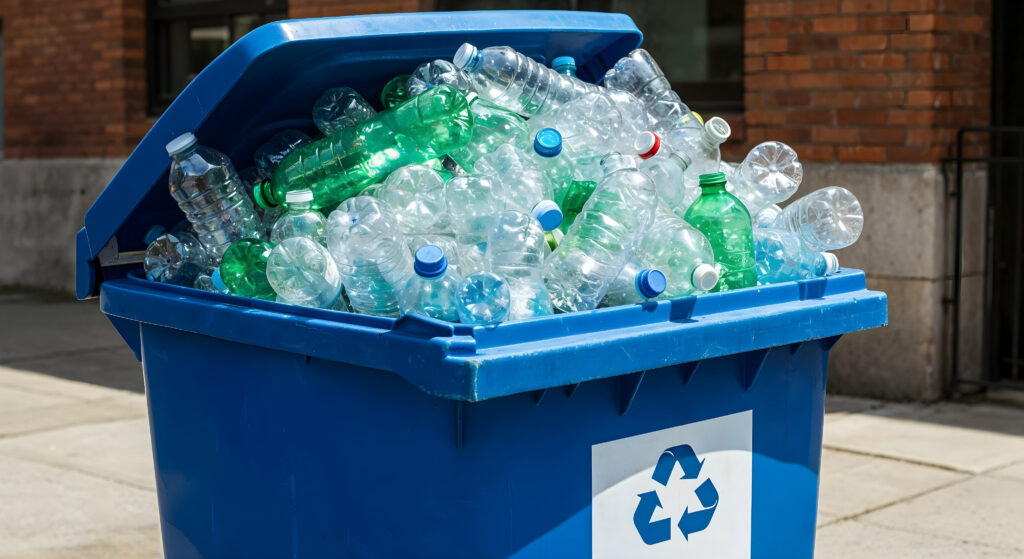
Think you’re making a positive impact when it comes to recycling? You’re probably not.
Recent research from the EPA says that only 13.6% of plastic packaging makes it through the recycling process.
Even though you’re diligently sorting your recyclables and placing them in your collection bins each week, what happens next is the problem.
According to Keep America Beautiful, 87 percent of Americans consider recycling important. And 62 percent give themselves an “A” or “B” for how they manage their waste.
But how can we give ourselves high grades when the end result is so dismal? And why do we trust a process that fails most of the time?
Recycling Reinforces Consumption
Researchers reported two revealing tests in a Journal of Consumer Psychology study. In the first, participants consumed almost twice the paper when the room included a recycling bin. Next, the researchers added a recycling bin near the sinks in a restroom. Paper towel use went up.
Their conclusion was that access to recycling made heavier consumption feel less guilt inducing. People could increase their waste while still seeing themselves as responsible.
So, when recycling is available, we feel less guilty about how much we’re using. We consume, and then convince ourselves whatever is left is going full cycle back to create another useful product.
Doing Something Good Doesn’t Mean Something Good is Happening
Recycling feel good. It gives us a sense of control, like we’re having a small impact on a bigger, even somewhat existential problem.
What we don’t realize is that our actions only really make a difference if the downstream system uses what we do in the intended way. Right now, it doesn’t.
Perhaps if you’re reading this you weren’t aware of the dismal record of recycling. I know I wasn’t fully aware of this until I stumbled upon the EPA research report. But this dynamic goes beyond just recycling. It’s something I’ve seen across the multitude of organizations I’ve help become more efficient and productive.
Here’s how it works:
-
- Immediate emotional payoff. Recycle as an action lets us feel complete closure when we do it.
- Limited process view. The end step of our process happens at the curb when our recycling is picked up. We rarely think about what happens at the sorting facility we never visit.
- Fragmented accountability. The consumer, hauler, and resin buyer participate and lead different parts of the process.
In many organizations, you get people measuring the success of what they do, not the outcome of their work. They count the number of ideas they come up with as “innovation” without looking at new revenue or cost reduction results. They treat training success as the number of people trained versus the real impact on organizational capability. When we look at activities as the goal we miss the real outcome we’re striving for.
Connect the Reward to the Result
The goal is to design systems that work together.
With a 90.4 percent redemption rate in 2024, Oregon’s bottle deposit system led every state in the country. People get their money back when the container is returned. Reward and result occur at the same moment. That’s just the first step.
Procter & Gamble changed the package itself. Tide evo is the first major waterless detergent to come in a curbside-recyclable paper box that eliminates the plastic jug – something that’s barely getting recycled today. Not because people aren’t putting them in their bins, but because the downstream systems can’t handle them.
How to Find the Gap in Your Business
This pattern exists in every sector. To locate it in your company:
-
- List your metrics. Write down every measure that makes your team celebrate success.
- Categorize your measures. Mark each metric as an “activity” or “outcome” that contributes to your company’s strategic goals.
- Refocus on input vs output. Reframe your team’s goals around the inputs that you provide to larger goals (your activities) versus the outputs you support (the ultimate outcomes like reduced costs or improved revenue).
The recycling problem exposes a broader business issue. Once a system starts defining a single activity as success, the original goal can vanish from view.
Good intentions matter, but results are the ultimate measure.
I publish Leapfrogging the Headlines to help leaders cut through the noise, gain clarity on what’s happening, and make smarter decisions. Subscribe below to get each issue delivered free.

Join 30,000+ other leaders