

Elon Musk is worth about a trillion dollars. Bill Gates built Microsoft, one of the most successful companies in history. Oprah Winfrey went from poverty to becoming a billionaire and one of the most influential media figures in the world.
If money, access, power, and professional notoriety are the scorecard, these people have truly made it.
But that’s not necessarily the only way to measure “success.”
Clayton Christensen, the late Harvard Business School professor who developed the theory of disruptive innovation, raised this issue in his classic article, How Will You Measure Your Life? One of his key messages was that people often devote their time and energy to whatever provides the most immediate and visible evidence of achievement.
Careers provide short term measures quite well. You get promotions, raises, awards, and recognition, They’re quantifiable results.
Intangibles like quality relationships, however, don’t come with quarterly reports. Neither does character. Or supporting nonprofits or those in need. That’s where conventional scorecards fall short if you want a more holistic view of life success.
Build a Better Scorecard
Cornell psychologists Thomas Gilovich and Victoria Medvec studied how regret changes over time. Their research findings show that you might experience short term regret after you give harsh words to a friend or colleague. That’s normal.
But the more notable finding is that “inaction” produces the greatest regret over the long term – like not doing something you wished you had like starting a business, or passing up on an invitation or opportunity, or never apologizing to a friend for a ruptured relationship.
On top of this, Stanford psychologist Laura Carstensen’s research shows that when people perceive their remaining time as limited, priorities tend to shift away from focusing on external achievements in the world toward more emotionally meaningful goals and relationships – much of which is intangible. That makes sense given that 85 years of research from the Harvard Study of Adult Development has found that strong relationships are closely associated with happiness, health, and longevity.
I’ve seen all this in action through my leadership development programs and coaching with executive teams. On the surface, most discussions with my clients focus on goals focused on clear results tied to their business strategies and personal careers. Yet when I go deep with leaders, many reveal they yearn for more from their jobs and lives than being in the rat race – even when their position in the race leads to significant wealth and achievement.
Here’s a more holistic way to view your personal scorecard:
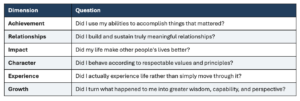
When you take all of these dimensions into account, suddenly the definition of “success” can instantly become a more attainable. Few people will become the next Elon Musk. Everyone has an opportunity to show up, deepen relationships, and make the world a better place.
Step back to build perspective
Public figures are intriguing to society precisely because they accentuate unidimensional comparisons. Elon Musk’s extraordinary entrepreneurial achievements tell us something important about one dimension of his life, but they cannot give us his complete score. Bill Gates’s business accomplishments and enormous philanthropic efforts reveal different dimensions. Oprah Winfrey’s career, philanthropy, and focus on personal development and meaning reveal another pattern.
And there are many, many other examples of where wealth combined with powerful relationships can coexist alongside profound moral failure. Someone could score extraordinarily high on Achievement yet extraordinarily low on Character. Someone else might never achieve fame and fortune but score high on Relationships, Experience, Character, and Impact. There are many people out there like this.
It’s important to be careful. Assuming we know another person’s score tied to their private relationships, satisfaction in life, or sense of fulfillment becomes a subjective exercise that provides little value. Unless, however, we’re comparing ourselves to others to feel better about our current position in life, which isn’t exactly the most healthy thing to do. The only scorecard you can really complete and fully understand is your own.
Experiences elevate your score
There’s another dimension I’ve come to appreciate through my research on Experiential Intelligence, which is how your experiences shape your abilities.
Your experiences can lead to building personal assets you can use in work and life. Your successes, setbacks, failures, relationships, hardships, risks, mistakes, and surprises you’ve accumulated all influence what you’re capable of doing next.
And that changes how we think about accomplishments. A failure that produces wisdom may contribute more to your life than an achievement that produces another promotion. A difficult conversation can teach you that empathy matters, so you can do it differently next time.
Our experiences can just happen to us, which means we’re not fully in control of them. But we can indeed shape the kind of experiences we create for ourselves, our teams, and our families.
Some simple ways to elevate your scores by having meaningful experiences include:
-
- Take a trip to another country to experience a new culture.
- Start a company.
- Call a long-lost friend.
- Leave something that isn’t working.
- Just try something new.
It’s through your experiences that you give yourself the opportunity to build out a more robust scorecard.
So, take the six dimensions above and give yourself a High, Medium, or Low. Then ask yourself one more question: If this were my final scorecard, which score would I most regret not changing?
And then change it so you can be even more “successful.”
I publish Leapfrogging the Headlines to help leaders cut through the noise, gain clarity on what’s happening, and make smarter decisions. Subscribe below to get each issue delivered free.

Join 30,000+ other leaders