

Investment property AI tools can transform how you analyze and grow your real estate portfolio. By tapping into artificial intelligence, you gain deeper insights into property valuations, rental demand, and market performance, all in a fraction of the time it used to take. As a real estate investment professional, you know that staying ahead of the competition requires top-tier resources. Below, you’ll explore how AI-powered software can help you make smarter decisions, save valuable hours, and reduce costly missteps.
Embrace AI for better decisions
AI in real estate goes beyond simple automation. Intelligent algorithms can sift through massive amounts of data, reveal valuable patterns, and offer projections you might miss on your own. As a result, you can focus on negotiating deals, building relationships, and strategizing your next investment moves.
- Save time on routine tasks: AI tools gather listing information, run rental comps, and calculate key metrics like cap rate, cash-on-cash return, or net operating income.
- Reduce human error: Machine learning learns from you, so it refines forecasts with every new data point, cutting down on guesswork.
- Improve risk management: By identifying red flags early, AI helps you sidestep bad deals or problematic markets before they cause financial strain.
Using investment property AI tools means you can focus your energy where it truly matters—closing profitable deals. Everything else, from extracting relevant property data to performing in-depth analysis, can be automated in a way that flows right into your decision-making process.
Leverage advanced data analytics
Take a closer look at how these tools collect and process data. Traditional real estate analysis often involves juggling multiple spreadsheets and dozens of browser tabs. AI real estate investment software alleviates that hassle by synchronizing all your data sources into one cohesive view.
- Use large datasets effectively: Many AI platforms pull from national listing services, demographic databases, and even social media signals to help you see how an area might evolve over time.
- Blend quantitative and qualitative data: AI can incorporate everything from local permitting for development projects to employment trends, giving you a fuller view of a potential investment’s future.
- Visualize results swiftly: Interactive dashboards help you spot anomalies or opportunities at a glance, rather than scrolling through row after row of numbers.
When a platform effortlessly merges your loan details, tax history, and neighborhood analytics, you spend less time cross-checking data and more time planning your next real estate move. By leveraging advanced data analytics, you can zero in on opportunities that best fit your risk profile and expected returns.
Use predictive modeling smartly
Predictive modeling might sound high-tech, but it’s simply a matter of letting algorithms forecast how a property might perform based on historical and real-time data. If you track year-over-year trends, AI can plug those data points into statistical models and produce insights like probable rental demand, future property values, or optimal rent rates.
The benefit? You can:
- Make faster offers: If the model indicates a property is undervalued for its rental potential, you can act swiftly to secure it before the competition does.
- Validate your instincts: Whether you’re a seasoned professional or just starting out, you have gut feelings about a market. Predictive models either confirm or challenge those hunches based on evidence.
- Plan for worst-case scenarios: AI can simulate various economic climates, letting you see how an investment performs even during a downturn or if local rent regulations tighten.
As you use predictive modeling, keep feeding it fresh data. The more detail you include, the more accurate these models become. Over time, you’ll trust these forecasts to guide your investment strategy and help you optimize your portfolio.
Make Smarter Rental Investments & Boost Profits
 Use AI to Assess Opportunities
Compare Cap Rates & Cash Flows
Optimize Rental Income
Use AI to Assess Opportunities
Compare Cap Rates & Cash Flows
Optimize Rental Income
RentalOptimizer.com
Compare potential properties quickly
If you’ve ever struggled to compare multiple properties in different neighborhoods, AI can simplify that process. Many investment property AI tools include built-in comparison features that let you view side-by-side metrics. This is especially handy when you’re considering multiple investments and want to quickly spot which one is best aligned with your goals.
Here’s how comparison tools can streamline your workflow:
- Uniform metrics: Instead of manually calculating metrics like ROI, cap rate, or occupancy rates for each property, AI aggregates that data automatically.
- Clear visuals: Interactive charts or tables highlight which property excels in rental income, appreciation potential, or place-based amenities.
- Configurable filters: Narrow down your options by specifying your must-have features, whether it’s a minimum lot size, certain proximity to public transit, or a particular price range.
When your data is standardized and easy to sort, you can make clear, confident investments. Plus, if any listing stands out for all the wrong reasons—like hidden costs or limited equity growth potential—you can weed it out right away.
Monitor portfolio health in real time
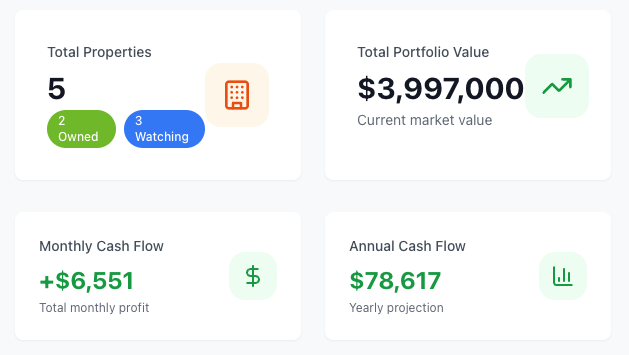
Buying a property is just the beginning. Managing your investment’s performance is where AI tools really shine. Instead of sifting through different investment statements and logs, real-time dashboards keep track of rental income, maintenance expenses, and occupancy trends. That means you’re always up to date, no matter how many units you own.
What real-time monitoring can offer:
- Automated alerts: If your occupancy rate drops or maintenance costs spike, the AI can notify you promptly so you can take action.
- Comprehensive performance snapshot: Get a bird’s-eye view of your total cash flow, net operating income, and return on equity across all your properties.
- Portfolio growth guidance: AI tools might even suggest expansions or renovations that could increase rental income in your properties.
Ongoing visibility into your performance empowers you to make swift, data-driven adjustments. You’re not just collecting data for the sake of analysis—you’re leveraging it to ensure your investments remain profitable in shifting market conditions.
Explore dynamic market insights
Beyond individual properties, you also want a handle on local market conditions. AI real estate investment software typically taps into job market trends, population shifts, and housing supply-demand metrics to give you a holistic perspective. This view helps you decide where next to invest and whether certain properties still fit your long-term strategy.
- Job growth and migration: A region with an influx of workers often signals higher rental demand, while stagnant or declining employment can be a warning sign.
- Neighborhood amenities: AI software can map out supermarkets, parks, transit lines, and schools in an area. This not only impacts rental desirability but can also influence long-term appreciation.
- Seasonality: Data can show if a rental’s busiest months align with certain times of year—vital if you’re focused on vacation properties or a cluster of college rentals.
When you have AI feeding you up-to-date market insights, you’ll think twice before jumping into a deal that looks good on paper but might not pencil out in reality. In hot markets, real-time data also becomes your secret weapon, helping you negotiate effectively and pivot if conditions change.
Test a leading AI tool
One standout example in the new breed of AI-powered applications for rental property analysis is Rental Optimizer (https://rentaloptimizer.com). This platform offers a streamlined approach to property assessments and ongoing portfolio tracking, all with the help of machine learning.
What makes Rental Optimizer unique?
- Intuitive interface: You can pop in your property address or features, and the tool instantly reveals estimated rental income, vacancy rates, and neighborhood stats.
- Ongoing updates: As you acquire new properties or market conditions evolve, the software recalculates everything in near real time so your portfolio’s metrics are never outdated.
- Smart notifications: If you experience unusual rent fluctuations or a spike in maintenance requests, Rental Optimizer can let you know right away so you can investigate before minor issues escalate.
Testing a tool like Rental Optimizer can help you decide if this new wave of AI software is right for your strategy. Even if you choose a different platform down the road, the experience will open your eyes to the efficiency gains and competitive advantages AI can bring to your real estate endeavors.
Key takeaways
- Investment property AI tools help you automate research, improve your forecasts, and manage properties at scale.
- Leveraging advanced data analytics reduces the time you spend collecting, cleaning, and interpreting numbers.
- Predictive modeling evaluates market trends and scenarios so you can confirm or challenge your instincts.
- AI-driven comparison features sort through multiple properties with consistent metrics, enabling a quick and thorough evaluation.
- Monitoring real-time performance allows you to fix issues faster and capitalize on emerging opportunities.
- Rental Optimizer (https://rentaloptimizer.com) exemplifies how AI can simplify rental analysis with its intuitive interface and live metrics.
Consider exploring at least one AI-driven solution to see how it fits with your workflow. You might be surprised by how effortless it becomes to conduct thorough property analyses, compare potential deals, and keep tabs on your existing rentals—all with ease. By adopting the right software, you position yourself at the forefront of modern real estate investing, well-equipped to meet the industry’s shifting demands.
Make Smarter Rental Investments & Boost Profits
Use AI to Assess Opportunities
Compare Cap Rates & Cash Flows
Optimize Rental Income
RentalOptimizer.com