

Investing in real estate can sometimes feel like a juggling act. You have to analyze multiple properties, predict market trends, and pinpoint your best cash-flow opportunities. That is where AI property investment analysis comes in. By using artificial intelligence to evaluate and compare real estate data, you can uncover insights that would be tough to find on your own. Below, you will learn how to harness AI to streamline your research, make confident decisions, and ultimately maximize your returns. Whether you are adding your first property or managing a diverse portfolio, these tips, tools, and strategies will help you move forward with clarity.
Explore AI property investment analysis
AI property investment analysis involves using machine learning models and algorithms to sift through all the numbers, documents, and market insights you need to make strong business choices. Rather than manually sorting through local property records or relying on gut feelings, you turn to advanced software systems that perform the groundwork for you. As a result, you can pick out the most promising opportunities faster and with more accuracy.
- Analyze large sets of historical data to forecast future growth in a neighborhood
- Compare property values to current market trends and identify potential undervalued deals
- Streamline calculations for cash flow, debt-to-income ratios, and more
By feeding the right data into an AI-enabled platform, you relieve yourself of tedious tasks and free up time to strategize how you want to structure your investments. If a particular real estate opportunity shows strong potential, AI can highlight key figures that you might otherwise miss.
Why AI matters now
On top of saving you time, these tools reduce the risk of human error. Even the most seasoned investor can overlook small warning signals when juggling multiple properties. AI removes a significant portion of guesswork by sifting through documents, public records, and real-time market data. This comprehensive approach positions you to make more objective decisions. You no longer have to wonder if a property is as good as it looks on the surface. Instead, you can consult concrete data and forecasts that help you pinpoint genuine opportunities.
Define your investment metrics
Before diving into any property, you want to iron out your investment goals. AI shines when you know exactly what you are looking for. Each property you consider should align with the specific metrics that matter most to you. By defining your metrics early, you help AI platforms deliver the insights that guide your final decision.
- Cash flow: Monthly net income after all expenses
- Cap rate: Ratio of net operating income (NOI) to property value, expressed as a percentage
- Return on investment (ROI): Overall profitability of a property based on the total money you put in
- Occupancy and vacancy rates: How often your units remain occupied vs. vacant
Match metrics to strategy
The best metrics for you depend heavily on your long-term strategy and risk tolerance. For instance, you might want a steady monthly income with minimal upfront costs. Or perhaps you seek properties in markets that are about to boom, aiming for higher appreciation. By clarifying your end goal, you can configure most AI investment systems to highlight properties that fit your targets.
When you zero in on meaningful figures, your AI property investment analysis becomes more powerful. It can cross-reference relevant historical data, neighborhood ratings, and real-time economic indicators, focusing on what drives your success.
Make Smarter Rental Investments & Boost Profits
 Use AI to Assess Opportunities
Compare Cap Rates & Cash Flows
Optimize Rental Income
Use AI to Assess Opportunities
Compare Cap Rates & Cash Flows
Optimize Rental Income
RentalOptimizer.com
Find the right software tools
Dozens of AI real estate investment products have hit the market in recent years. You will see everything from basic calculators to robust platforms offering automated portfolio tracking. One standout example of this new generation of AI-powered applications is Rental Optimizer. It specializes in rental property analysis, helping you gauge both short- and long-term profitability and track existing properties as your portfolio evolves.
Features to watch for
When choosing an AI tool, you want to make sure it aligns with your personal style of investing. Look for:
- Data coverage: Confirm it sources relevant data for your target markets.
- Forecasting models: Make sure it provides projections based on current and historical figures.
- Customization: Ensure you can fine-tune your criteria to match your investment style (e.g., buy-and-hold, fix-and-flip).
- User interface: A clean interface and intuitive navigation will speed up your workflow.
- Integration: If you already use a real estate CRM or have property management software in place, confirm that the new platform can integrate with your existing systems.
Once you have found a software tool that fits your style, it can transform your day-to-day routine. By combining advanced analytics with your intuition, you build a more concrete foundation for your investments.
Stay data-driven in decisions
The real estate market can shift quickly, and emotion-based decisions may not always serve your best interests. AI property investment analysis tools help you keep the focus on numbers and verifiable data. That way, you are spotting trends and taking advantage of growth opportunities before the rest of the market catches on.
- Compare rental rates in your chosen neighborhood to the regional average
- Track the effect of local economic changes or job growth on property demand
- Estimate future appreciation or cash flow under varying economic scenarios
Balance data with personal insight
While it is important to remain data-driven, you do not want to lose touch with the human elements of investing. Tenant satisfaction, local aesthetics, and community reputation still matter. AI may tell you a particular neighborhood is on par financially, but if it is notorious for high tenant turnover or tricky zoning rules, you could face unexpected hurdles. Blend AI-driven insights with on-the-ground knowledge to build a well-rounded view of any property you are considering.
Monitor outcomes in real time
One of the biggest advantages to using AI is the capacity for live tracking. Once you close on a property, analysis should not end. Ongoing monitoring helps you catch early warning signs if expenses begin to creep up or if a market starts to cool. AI tools that provide frequent updates about rental income, property maintenance costs, and prevailing rental rates let you make adjustments without missing a beat.
Automate reports
Advanced platforms often let you automate reporting and alerts:
- Receive monthly or even weekly snapshots of your portfolio’s performance
- Set triggers that notify you when occupancy hits a defined threshold
- Track local market fluctuations or neighborhood development news
If the data shows that you are consistently dealing with repair costs in one unit, you know to investigate deeper before it turns into a larger financial drain. Or if your short-term rentals are facing sudden vacancy, you can quickly switch gears and create incentive programs or promotions. AI keeps you alert to evolving conditions and supports faster, smarter reactions.
Expand your portfolio strategy
More properties mean more complexity. As your portfolio grows, even small oversights can get magnified across multiple assets. This is exactly why AI property investment analysis can make a real difference. AI learns from each property you own, refining its predictive modeling over time. By documenting patterns in your current properties, it can guide you toward the type of real estate that will help your portfolio thrive.
Scale without overwhelm
You might love the idea of acquiring a new multi-family complex, but are not sure if your existing data can support that scale. A robust AI solution will automate many of the manual tasks that come with expansion:
- Evaluating the local rental market for a range of property types
- Forecasting possible returns based on multiple financing scenarios
- Tracking property performance across regions or states
Adding a property to your portfolio no longer feels overwhelming because you do not have to factor in every single expense or demographic by hand. You let the software accelerate your research, and you use those results to finalize your game plan.
Track emerging market trends
AI can help you look beyond property-level analysis and see the broader trends that will affect your returns. Are more tech companies opening offices in a particular city? Are home prices soaring in new suburban developments due to a shift in work-from-home policies? AI is especially good at synthesizing news, economic indicators, and local demographic changes into meaningful insights.
- Evaluate gentrifying neighborhoods and growth corridors
- Watch mortgage rates and how they affect overall demand
- Spot up-and-coming cities with strong job markets
Use AI as part of your toolkit
Trends do not always unfold in a perfectly linear way. Political changes, unexpected economic shocks, and even natural disasters can impact real estate markets. AI is not a crystal ball, but it does give you more context for decision-making. You will see patterns that might otherwise go unnoticed, especially if you invest in multiple locations with different local economies. As you continue to use these tools, you will notice how they refine themselves, becoming even smarter about what you value most in a property.
Combine AI with on-site research
No matter how advanced the software, you still want to visit properties in person if at all possible. An AI tool can tell you a building has a strong ROI. However, it may not account for old wiring or subpar plumbing. Even if it has some data about maintenance, nothing compares to stepping onto the property to assess the condition of the structure, neighborhood roads, and nearby amenities.
Use AI data to drive your choice of which properties to tour. Rather than stepping into 20 potential houses blindly, you can narrow it down to the five most promising ones. Next, inspect those five in person to confirm the numbers line up with the reality on the ground. This blend of technology and physical due diligence helps you proceed confidently.
Consider risk management strategies
Every investment carries some level of risk, and real estate is no exception. AI helps you keep certain risks in check, but it is also wise to have a backup plan. If property demand in one area stalls, do you have enough diversity in your portfolio to stay profitable? If your rental property hits a stretch of high vacancy, how will you cover the mortgage?
- Build an emergency fund for unexpected repairs or slow periods
- Diversify across multiple property types or neighborhoods
- Revisit your financing options to negotiate better terms if interest rates shift
Many AI platforms incorporate risk metrics too. You might see a projected downside scenario that shows how your investment performs if rents fall by 5 percent or if you face a jump in property taxes. By running these simulations, you gain valuable insight into your worst-case scenarios.
Make financing easier
Banks and lenders often require an avalanche of data points before issuing a loan for investment properties. By using AI property investment analysis, you can compile these metrics more easily. Demonstrating strong forecasted cash flow, stable local trends, and property comps in your area can improve your credibility when seeking financing. The more concrete data you bring to the table, the easier it is to show lenders that you have done your research.
Prepare a clear pitch
If you plan to partner with others or attract new investors, you will need a sharp presentation that outlines the perks of your proposed deal. AI-based reports allow you to show prospective partners:
- Expected monthly and annual income
- Estimated appreciation over time
- Detailed breakdown of expenses (mortgage, maintenance, insurance, taxes)
These data points show you have taken a systematic approach. You can combine them into short, eye-catching pitches that inspire confidence and garner buy-in from stakeholders.
Optimize property management
Beyond initial acquisition, day-to-day management of your rental units can be supported by AI. Some tools will automatically analyze which repairs or upgrades would be most beneficial for boosting your returns. Others will run credit checks on prospective tenants or track rent payments across your portfolio.
- Automate routine services like monthly cleaning or lawn care
- Track tenant feedback and satisfaction ratings
- Evaluate which amenities (laundry services, gym access) might help you command higher rents
When you manage properties with AI, you reduce the chance of letting small issues slip through the cracks. Over time, efficient property management leads to better reviews, stronger tenant retention, and fewer costly surprises.
Integrate everything in one dashboard
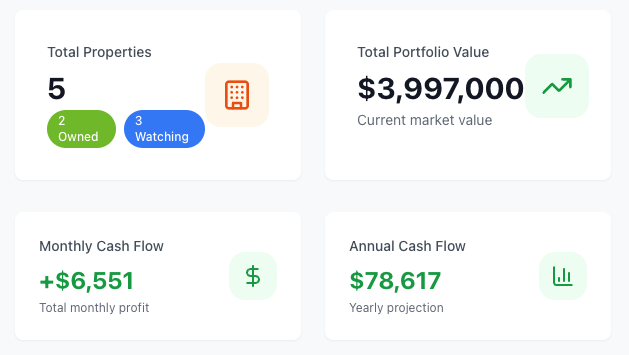
A well-chosen AI platform, such as Rental Optimizer, can streamline your entire process within a single interface. You can review your current holdings, analyze prospective acquisitions, and monitor local market shifts without jumping between multiple programs. This high-level overview of your real estate investments saves time and prevents data silos.
- Keep property records, loan details, and occupant info updated in real time
- Evaluate how rental income compares to your monthly targets with refreshable reports
- Receive announcements about local property-related news directly in your dashboard
Plan for long-term growth
Your approach to real estate will naturally evolve. As you gain experience, your strategy might shift from income-focused to development-focused or vice versa. The benefit of relying on AI is that these tools can adapt with you.
- Realign your metrics to emphasize appreciation if you decide to hold properties longer
- Switch to short-term rental models if market demand changes
- Consider commercial or mixed-use properties if they match your investment goals
AI platforms allow you to track how each of your properties contributes to your overall financial picture. As you adjust your strategy, you will see how your potential returns transform.
Key takeaways
- Use AI property investment analysis to make smarter, data-driven decisions and reduce mistakes.
- Define clear metrics, such as cash flow and ROI, to shape the platform’s recommendations.
- Explore new AI tools like Rental Optimizer, which automates rental property analysis and portfolio tracking.
- Rely on automatic updates and alerts to anticipate changes in market conditions, risk factors, or tenant behavior.
- Combine AI research with in-person inspections and community insights for a well-rounded perspective.
- Keep an eye on broad market trends and local developments that may impact your returns.
- Incorporate AI results into your presentations for lenders or potential partners to increase credibility.
By embracing AI, you are not just optimizing your immediate investment decisions. You are also setting yourself up for long-term success. The real estate market may shift, but with quality data and predictive analytics at your side, you will be able to adjust your strategy and maintain an edge. Start by identifying the next property you want to evaluate. Then, let AI handle the deep calculations while you focus on what you do best: building a thriving real estate portfolio.
Make Smarter Rental Investments & Boost Profits
Use AI to Assess Opportunities
Compare Cap Rates & Cash Flows
Optimize Rental Income
RentalOptimizer.com