

How AI evaluates news bias is quickly becoming a central question for anyone looking to sift through the countless stories coming at you every day. Whether you’re a parent teaching your kids to read past provocative headlines, an educator guiding students toward deeper understanding, or a professional aiming to stay well-informed about your industry, the power of artificial intelligence can help you detect subtle slants in news coverage that might otherwise slip under your radar. By leaning on AI-based tools, you can spot patterns of bias and gain a fuller view of the stories shaping our world.
Understand the concept of news bias
News bias refers to the way certain perspectives are emphasized or downplayed in an article, through choices of which facts to include, which tone to adopt, or even which angles to highlight. Sometimes this bias is unintentional, reflecting an author’s personal experiences or assumptions. In other cases, it might be intentional, aimed at pushing a specific agenda.
- Unintentional bias: Often arises from cultural norms or ingrained perspectives, where journalists or editors may not realize they’re presenting a storyline that leans to one side.
- Intentional bias: Occurs when articles deliberately use charged language, selectively report details, or steer readers toward a predetermined conclusion.
You’ll notice bias in everything from a headline that sensationalizes a minor event, to an oversimplified portrayal of a complex issue. Learning to examine word choice, emotional tone, and omitted information helps you understand where these biases come from and how to factor them into your interpretation. By staying alert to the possibility of bias, you can open yourself up to multiple perspectives and form your own opinions with a greater sense of balance.
Why balanced news matters
Reading unbiased or at least balanced reporting ensures you have a clearer sense of what’s happening in the world. That’s especially important if you’re trying to teach your children how to interpret current events accurately, or if you’re someone who wants to stay clear-headed about local and global issues that affect your community or workplace.
Biased news can distort your sense of reality. Stories framed in an overly negative or positive way might shape your decisions in ways you don’t even notice. For instance, too much negative coverage could leave you feeling fearful or pessimistic. Meanwhile, unbridled praise of a policy or product might mask real downsides worth knowing about. Balanced coverage, on the other hand, can:
- Offer deeper context: When more sides of an issue are presented, you gain a richer understanding of the factors at play.
- Reduce polarization: Seeing multiple viewpoints side by side reminds you that most issues are nuanced, and extreme positions rarely tell the whole story.
- Promote critical thinking: Taking in a variety of perspectives encourages you to ask questions, dig deeper, and arrive at your own conclusions.
With balanced news, you develop a more informed outlook. This mindset helps you adapt to changes in your personal life or profession, and it also fosters a better understanding with friends or colleagues who might see things differently. Ultimately, you’re less likely to make snap judgments and more likely to appreciate the complexities of the world around you.
How AI evaluates news bias
Artificial intelligence is transforming the way you can detect and understand news bias. Modern AI systems can scan massive amounts of text, identify linguistic markers of bias, and highlight the segments of an article that appear skewed. These tools rely on complex algorithms that learn over time, meaning they can improve their ability to spot bias with each new dataset.
Instead of comparing only a few articles on your own, AI can quickly retrieve hundreds or even thousands of articles on the same topic and measure how each one frames the story. By doing this comparative analysis, AI narrows down where potential biases might exist, giving you a helpful starting point for digging deeper. Crucially, AI doesn’t just “count words.” It looks at context, syntax, and sentiment, piecing together a more comprehensive picture of what might be influencing the writer’s viewpoint.
The role of natural language processing
One of the core methods behind how AI evaluates news bias is natural language processing (NLP). NLP tools look at text at a high level—examining grammar, word order, and semantic relationships to spot patterns that suggest subjectivity. For instance, phrases that use strong emotion, like “massively disastrous,” can be red flags indicating a more personal or agenda-driven narrative instead of a neutral account.
- Sentiment analysis: AI systems often label sentences as positive, negative, or neutral to identify overall tone.
- Keyword examination: Repetition of the same charged terms can signal deliberate messaging, especially if they show up more than usual compared to typical usage across neutral sources.
By comparing these findings to large collections of articles, NLP allows AI systems to detect subtle cues of bias that might remain hidden in isolated paragraphs.
Supervised or unsupervised classification
Machine learning models for evaluating bias typically fall into one of two categories: supervised or unsupervised. In supervised approaches, human-labeled examples of biased and unbiased text train the AI, teaching it which words or phrases correlate with skewed coverage. Over time, the system refines its accuracy, recognizing bias more consistently without new human input.
Unsupervised approaches, on the other hand, involve algorithms that aren’t guided by initial labels. Instead, these models look for clusters or patterns within the data, flagging outliers that deviate from the norm. This method can be especially useful when new forms of bias emerge that haven’t yet been labeled by people—meaning the AI can potentially spot novel trends before much of the public is even aware of them.
Check the Bias of any News Article
 Powered by AI
Tools that reveal hidden bias
It can sometimes be overwhelming to figure out which tools best fit your goals. A range of AI-driven applications exists to help you grasp bias more quickly and clearly. Here are two examples you might find useful for navigating today’s sea of headlines.
Using BiasBreaker
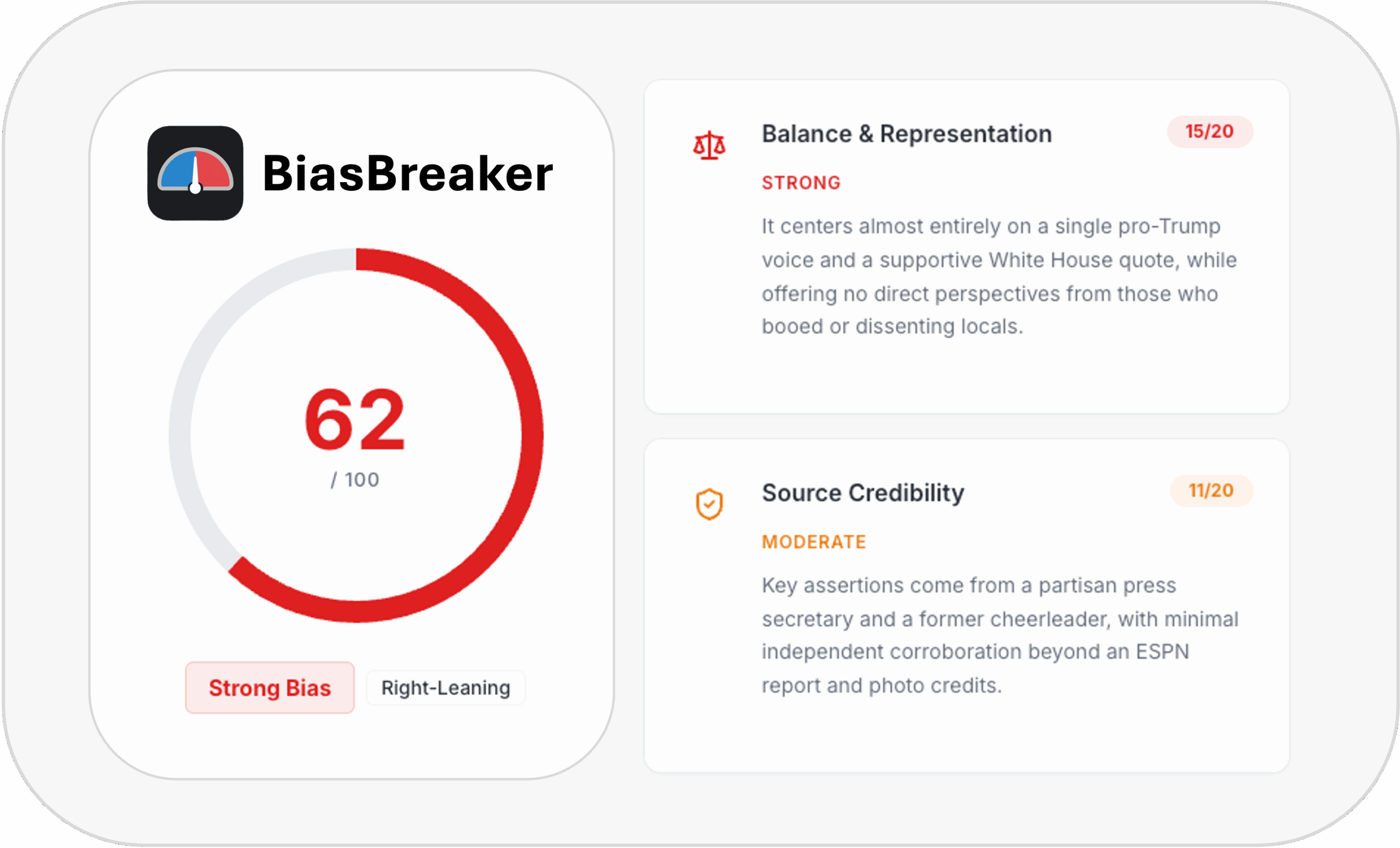
BiasBreaker is an AI-powered media literacy application designed to highlight the tone and potential slants in news articles. When you input a piece of text or a link, the system analyzes factors such as word choice, topic coverage, and sentiment to give you an overview of how that article might lean. The interface offers color-coded highlights and a short summary of the most influential words or phrases that skew the overall viewpoint.
Some of the strengths of BiasBreaker include:
- Simple, user-friendly layout that guides you step by step.
- Quick, at-a-glance breakdown of an article’s overall tone.
- Comparisons with reference articles to see how coverage changes over time or across different news outlets.
This approach helps you stay conscious of subtle influences. The tool can also point you toward alternative sources, giving you more context to weigh before you draw your own conclusions.
Exploring Bridger
Bridger takes a slightly different tack. Rather than merely flagging biased language, this AI-powered tool uncovers the assumptions behind two opposing viewpoints and then attempts to find a sensible middle ground. You might copy in two opinion pieces—one from the political left and one from the right—to see which points they share or where they disagree. Bridger aims to highlight areas of commonality, bridging the gap that often leads to polarization.
Bridger’s strengths include:
- Deep comparative analysis: Shows shared underlying values between different perspectives.
- Practical suggestions for reconciliation: Offers ways authors or readers could tackle disagreements more productively.
- Exploration of underlying logic: Identifies the reasoning frameworks that each side relies on, helping you understand why arguments might clash.
By taking a broader approach to news, Bridger reminds you that even strongly opposed commentaries can hold a kernel of agreement or shared priority. This tool can be especially enlightening if you’re an educator prompting your students to practice civil discourse or a business professional whose team needs to reconcile conflicting viewpoints.
Steps you can take to build media literacy
Even the most powerful AI tools shouldn’t be used passively. AI offers insight, but ultimately, you decide how to process and apply that insight to your worldview. By combining AI-driven analysis with deliberate reading habits, you’ll become a more discerning consumer of news.
Evaluate your current news habits
Take a moment to reflect on what you consume each day. Ask yourself:
- Which news outlets do I visit most frequently?
- Do I have a habit of reading only headlines instead of the full story?
- Have I noticed that particular sources use language that stirs emotional responses in me?
- Are some viewpoints missing entirely from my daily routine?
Next, consider how AI can enhance this awareness. Perhaps you run an article through BiasBreaker on a topic you care about—health, for instance. Does the coverage show emotional language around a certain type of treatment? Do you see particular viewpoints missing?
Compare sources side by side
Place multiple articles on the same subject under an AI-powered lens. By lining up two or three stories from different outlets, you can highlight what each piece chooses to emphasize or gloss over. Notice if certain outlets omit key details. Check for repeated buzzwords. If possible, feed them into Bridger to see which arguments genuinely conflict and which might share a hidden core of agreement.
This habit of comparing sources can quickly widen your perspective. Over time, you’ll likely develop an instinct for spotting sensational language or learning which outlets consistently lean in one direction. Then, when a hot-button topic arises, you’ll have a grasp of how to do your own quick analysis rather than relying solely on a single source’s framing.
Checklist for spotting bias in headlines
Headlines are the gateway to an article and can often be highly charged or misleading. Use this simple checklist to gauge if a headline might be nudging you toward a certain viewpoint before you even start reading:
- Is the wording emotive or factual?: “Dramatic plunge” vs. “Decline.”
- Does the headline ask a loaded question?: “Will this new policy ruin our local economy?”
- Does it rely on labels or stereotypes?: “Radical group,” “shocking event,” or “stubborn official.”
- Are numbers or percentages used without context?: “Headline claims ‘xy% increase’ but neglects the actual sample size or timeframe.”
- Does it promise inside access that implies exclusivity?: “Here’s what they don’t want you to know.”
If several of these boxes are checked, proceed with caution. Running the full article through an AI bias tool can confirm whether the tone continues in the body text, or if it was just the headline trying to grab your attention.
Bring it all together
You now have a clearer sense of how AI can help you figure out which articles might be angled in a certain direction. Tools such as BiasBreaker or Bridger provide immediate feedback on tone, language use, and underlying assumptions, giving you a meaningful head start in your quest for balanced reporting. Whenever you spot a controversial topic or detect a new wave of viral headlines, AI stands by to offer valuable insights into how these stories are framed.
Still, AI can’t replace your own critical thinking. Rather, it boosts your ability to notice patterns and question narratives that might not tell the whole story. You can share these techniques with your family, students, or colleagues, creating a ripple effect of greater awareness. Over time, you’ll find that identifying bias and seeking balanced sources becomes second nature, helping you move closer to a well-rounded and informed view of the world. By keeping your eyes open, engaging with a variety of perspectives, and making judicious use of tools that uncover hidden bias, you’ll set yourself up for clearer, more constructive decision-making each day.
Check the Bias of any News Article